The Verification Jig in Multiple Implant-Supported Prostheses within the Digital Workflow: A Scoping Review
Article Sidebar
Main Article Content
Abstract
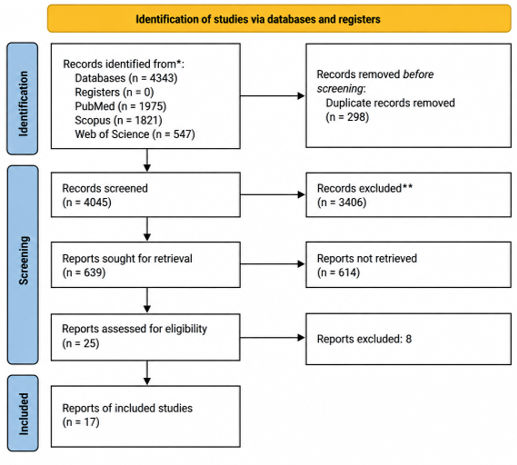
Passive fit is a mandatory prerequisite for the long-term mechanical stability of implant-supported full-arch prostheses, yet accurately transferring the three-dimensional implant position to the working cast or digital file remains the central technical challenge in this field. This scoping review, registered a priori on the Open Science Framework (DOI 10.17605/OSF.IO/VPKA7) and reported per PRISMA-ScR, mapped the methods, materials, and positional indexing devices, particularly the verification jig, used in multiple implant-supported full-arch prostheses within the digital workflow. PubMed/MEDLINE, Scopus, and Web of Science were searched without date or language restrictions. Of 4,341 records identified, 16 studies published between 2002 and 2025 were included. Five evaluated conventional resin jigs; the only clinical study among them associated jig use with 100% passive fit versus 14% without it. Eight studies evaluated digital scan aids, whose benefit depended on scanner optical technology, and one retrospective study validated a calibrated splinting framework with 100% passive fit and 97.8% one-year prosthetic survival. One study established an RMS error threshold below 62.2 µm as a virtual biomechanical safety parameter. The verification jig, whether conventional, CAD/CAM-milled, or functionally replaced by scan aids and calibrated frameworks, continues to be necessary for passive fit in most scenarios, based on current evidence, even within a fully digital workflow.